Hydronics:
Troubleshooting & Training
By Robert Bean
Radiant home heating is more popular and challenging than ever.
The number-one challenge for radiant heating during the 1970s was dealing with
failed steel and copper tubing installed following WWII. Between 1980 and 1990,
the difficulties were boiler, pump and expansion tank failures resulting from
corrosion and improper tube installation due to the introduction and misapplication
of new piping materials. Since 1990, it has been dealing with the soufflé
of control strategies and growing sophistication of systems in a market of declining
skilled installers. For 2004 and beyond, the test is a continuation of a shrinking
talent pool in charge of controlling not just separate furnace or radiant based
heating systems but an integration of the two methods.
How to fix it
Renovation contractors faced with repairing or reviving the WWII system might
as well start from scratch. The mechanical equipment will have reached or be
very close to the end of its useful life and any pipe failures are an indication
of nastier things to happen. Older projects can be retrofitted to use attractive
wall-mounted panel radiators or incorporate radiant walls or ceilings into the
structure. Eighties' systems might have used "non-barriered" pipe
leading to oxygen permeation and corrosion failures in ferrous components. Essentially,
these were like big lungs inhaling air through the pipe walls and into the water
creating rust.
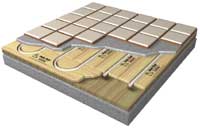
The common solution is to isolate the floor system from the boiler equipment
with stainless steel heat exchangers. Other challenges from this period include
the marriage between non-condensing boilers and the low-temperature radiant.
Floor systems typically operate below the condensing point of a boiler so if
fluid temperatures were run below 140ºF, gasses condensed on the exchanger
leading to plugged flue passages and, ultimately, back drafting. Lack of this
knowledge led many to ignore the need for mixing controls, so it was common
to operate boilers too hot or too cold. These systems can be resuscitated with
the installation of proper equipment.
The third thorn from this period came from ignoring basic building science as
it related to heat transfer.
Occasionally, uninsulated radiant slabs located over high water tables or highly
conductive soils did a fantastic job of warming up the aquifer but not the intended
building. There is little one can do to fix these assemblies and most are abandoned
as being too costly to operate. Owners of uninsulated main or second floors
find that radiant heat is directionless and influenced by floor coverings. Any
surface colder than the warmed floor would absorb heat, thus making it difficult,
if not impossible, to deliver energy to where it is required. Unfinished basement
ceilings are relatively easy to correct and, when completed, have better control
over the basement and main floor. Finished ceilings must be removed to gain
access to the underside of the floor.
Since the late 1980s, the art of designing radiant systems with sophisticated
software, refined installation methods and industry training programs have essentially
minimized most troubles related to the actually floor system. Any contractors
today still faced with problems related to new tube installation are advised
that a Google search of radiant heating brings up over 269,000 results. The
information contained in these sites is distilled from a few dozen manufacturers
and a handful of research universities and mechanical associations responsible
for radiant design and installation methods. Tube installation in this decade
should not be a problem for any professional firm offering radiant systems.
Today's problem
The challenge from the 1990s is the plethora of constantly updated control strategies
or introductions of new electronics by a growing field of competitors. For the
most part, if the 1990s system has been operating as designed, the only concern
is due to mechanical or electrical failure from normal wear and tear. If or
when these controls fail, they can be replaced with identical components or
updated with newer versions including modern Web-based communication options.
If the system has never worked properly, more often than not it has not been
set up correctly. I know of one customer who operated a system for six years
with excessively high heating bills, noise, and equipment failure, all solved
in less than four hours by a competent controls contractor.
The evolving modern quandary is coming from the integration of air and radiant
systems inside highly efficient structures. Since these systems behave differently,
it is necessary to have an understanding of how they work together to deliver
combined performances.
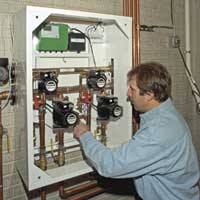
The future may sound like a real challenge but manufacturers now produce pre-assembled
control panels or complete systems to deal with the sophistication. All the
components required to address air and comfort quality are engineered and assembled
at the factory. The more advanced manufacturers incorporate Web-based hardware
and software for the option of having 24-7 monitoring of systems. Think of these
controls as the HVAC's equivalent to GM's Onstar(c) product.
No doubt the industry has gone through some growing pains. Still, it is estimated
that over 182 million square feet of radiant was installed in North America
last year and the trend continues to heat up. The biggest change is not in tube
and manifolds. The largest improvements have come in controls and boilers. The
HVAC system of tomorrow is beginning to look like most other electromechanical
appliances in the home: plug-and-play rather than some science experiment of
the past. This, fortunately, makes the systems easier to understand and simpler
to install.
Courses offered
The Heating Refrigeration and Air Conditioning Institute of Canada, with funding
from NRCan through the R-2000 housing program, has completed the first radiant
hydronics design certification course in Calgary with follow-up programs scheduled
in other Canadian cities.
The next seminars are planned for: September 20 to 22 in Vancouver, September
27 to 29 in Toronto, September 30 to October 2 in Toronto, October 5 to 7 in
Halifax, and October 28 to 30 in Sudbury. HB
Robert Bean is a registered engineering technologist in the discipline of
building construction engineering and operates www.healthyheating .com, a Web
site for contractors, consumers, and designers, which specializes in health,
wellness, and comfort housing solutions for an aging population. He can be contacted
at info@healthy heating.com.
Photo credit: Robert Bean/HRAI
homeBUILDERcanada.com | Home BUILDER Magazine | Canada's #1 Information Source for Residential Home Builders and Professional Renovators