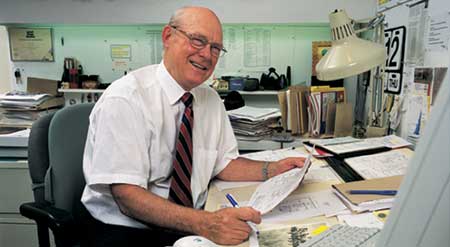
When the Greater Toronto Home Builders' Association bestowed a Lifetime Achievement
Award upon Ken Viljoen this summer, it recognized the influential stamp the
prolific South Africa-born architect and designer has forged in his adopted
city.
Viljoen, 66, is president of Viljoen Architect of North Toronto. Over the past
3 decades, he has taken the lead in his firm's design of at least 10,000 new
homes, captured numerous design awards and proved a mentor to most designers
specializing in low-rise residential construction in the Greater Toronto Area.
Viljoen, who arrived in Toronto in 1965 and completed his Masters Degree in
urban design from the University of Toronto two years later, has crafted complete
communities, low-rise and high-rise homes and private residences for Toronto's
most prominent builders. Yet it is his pragmatic approach to design and a noted
talent in matching architecture to on-site reality that is perhaps Viljoen's
most enduring trademark.
"What you can't lose sight of is that you are designing for someone who
is eventually going to purchase," Viljoen explains. "You must capture
the public's eye." He is also known for designs that are practical to build.
"The work at the production end is critically important. If the framer
can't put it together, then you have a problem."
Viljoen bristles at suggestions that architects dictate design trends. Instead,
he says, good design bubbles up from the market. According to Viljoen, what
appears to be nostalgia - such as the Craftsman and Victorian designs and "the
new urbanism" of some suburban neighbourhoods - is simply a reflection
of a consumer's continuing search for security, comfort and value. Knowing the
pulse of the consumer, anticipating what will sell two or even three years out
- and the equally important ability to recognize and reject shallow trends -
is important to a designer's success. Viljoen is among those with these rare
talents.
An example is the town homes that he designed for the Millcroft golf course
development by Monarch Homes in Burlington, Ontario, nearly twenty years ago.
Today the homes remain a signature project within the giant Monarch portfolio
and representative of timeless residential design with consistent resale demand.
In fact, clones of Viljoen's design for Millcroft can now be seen in high-end
resort developments across Canada. ("Our work gets ripped off all the time,"
Viljoen says with a laugh. "That's why you have to survive on service and
quality, not just good design.")
After 33 years in the business, Viljoen is skeptical about some of the purported
trends in new homes. For instance, Flex housing, while touted as a cure-all
for a growing family, is "too complicated and impractical" for most
mainline single-family builders, he says. "The code problems can be horrendous."
And, while Viljoen and his 33-person office consistently incorporate R-2000
technology into their designs, he says pushing the "green" envelope
further is often cost-prohibitive for the average builder. "Green architecture
and design has to start with the land developer to be truly effective,"
he explains.
But there is one overriding trend in metro Toronto that Viljoen believes will
dictate home building and design for years to come: the restrictions on land
development, such as the Ontario government's moratorium on rezoning in the
Golden Horseshoe, and subsequent soaring land costs. "Intense densification
is a reality," Viljoen says. "We have no choice."
The cost of serviced land will increase pressure to build more high-rise condos
and low-rise town homes rather than tracts of single-family houses on wide streets,
he explains, and higher-density communities clustered near light transit hubs
are the inevitable future for southern Ontario. Viljoen notes that, while it
cost about a $1 billion to extend the Yonge-Shephard rapid transit line from
Toronto, about $5 billion in private development has sprung up around the stations.
As a result, Toronto-area home builders will increasingly find themselves working
in ultra-planned communities, Viljoen says. "We are no longer building
homes; we are building neighbourhoods." The emphasis on urban design, he
adds, has already elevated new home architecture in the city.
Despite its prolific production, Viljoen Architect does not create stock house
plans. Each design is done for a specific client, Viljoen explains, and "although
we own the copyright, I feel it is the client's design. I would never try to
sell it to someone else."
At the Viljoen Architect's offices and studio in North Toronto, staff are largely
recruited from community colleges and have training both in design and construction,
Viljoen says. His staff are taught to respect the technical and logistic aspects
of home design as much as the creativity. Home builders should also choose designers
carefully, he adds, because the few dollars saved with a "kitchen table
designer is nothing compared to the cost if there is a site problem that will
delay construction."
"We train all of our staff as if they will be here for years," he
says. In reality, some former Viljoen designers have gone on to become active
competitors. Viljoen has no problem with that. "There is plenty of room
for good designers in Toronto today, besides which it keeps you on your toes."
Married and the father of two grown sons, Viljoen and his wife, Ann, live in
a 50-year-old renovated house on a ravine lot a block off Toronto's Yonge Street
and he looks forward to continuing an active career in Canada's biggest city.
"Some people say we are in the eighth year of a seven-year building boom,"
Viljoen says, "but I believe there is a strong future for new homes in
Toronto."
And there are few doubts about who will be designing many of them. HB
homeBUILDERcanada.com | Home BUILDER Magazine | Canada's #1 Information Source for Residential Home Builders and Professional Renovators