"Building is cool"
Trades training sees mixed success
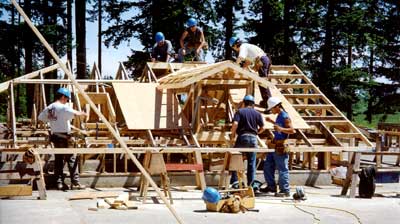 Students
at Discovery Community College in Campbell River, B.C., learn "Forming
and Framing", a 22-week competency-based program where trainees complete
construction of a frame structure to "lockup", gaining plenty of hands-on
experience with full-sized roof framing.
Students
at Discovery Community College in Campbell River, B.C., learn "Forming
and Framing", a 22-week competency-based program where trainees complete
construction of a frame structure to "lockup", gaining plenty of hands-on
experience with full-sized roof framing. |
When British Columbia's
Industry Training Authority set targets for enrollment in trades training
in March 2004, the agency expected 30,000 students would be in apprentice
programs within three years.
Instead, ten months into the program, enrollment had nearly surpassed the
three-year target. "There is a rush of young people into the trades,
and half of them are going into the construction sector," an ITA spokesperson
said. The B.C. success is not being mirrored in all parts of Canada, though
there are flashpoints of growth.
As of January 31, there were 18,985 B.C. apprentices registered, up nearly
30 per cent from March 31, 2004. There were also 9,720 employer/sponsors training
apprentices, up eight per cent over the same time period, putting the takeup
nearly equal to the three-year target.
Youth participation is also exceeding targets, due primarily to the launch
of the "ACE IT" program that brings trade training into high schools.
While 400 students were expected to enroll in the first intake in January,
actual registration is more than 1,100, with an additional 700 to 900 students
forecast to participate in the second intake later this year.
In addition to registered apprentices, the ITA estimates that there are more
than 10,000 British Columbians currently enrolled in Entry Level Trades Training
(ELTT) programs at B.C. post-secondary institutions. That represents an increase
of 17 per cent in 10 months for industry training over all.
This February, the CHBA-BC reported the first graduates of the new Residential
Construction Framing Technician certification program and noted that 71 of
76 trainees are doing on-the-job training.
"Building stuff is cool," said Peter Fromanger, a 19-year-high school
graduate who is now enrolled in a 22-week forming and framing course in Abbotsford.
"I already have a job lined up." That's not a problem in B.C.'s
overheated housing market, where the starting pay for framers is $17 an hour…
and many make twice that.
Most first-year university students won't be making that kind of money for
years and the message is getting out.
Ottawa
antes up
In 2004, the federal government spent $12 million to market the trades to
students, teachers and, most importantly, parents. The message, often driven
home by local members of the CHBA, is that the employment rate for skilled
trades is better than university graduates and there are opportunities for
rapid advancement if you have the right stuff.
Across Canada, the take-up in construction trades training is mixed. Newfoundland
and Labrador home builders rely on the "on the job" training that
has characterized the industry for years. The bulk of the industrial training
offered in the province is geared toward the resource industry and is focused
on union participation, not on residential construction. However, Atlantic
Canada has an aggressive construction training system in place and Mary Kenny
of the Atlantic Home Builders' Training Board confirms that, while more training
is being offered, most is aimed at upgrading the skills of existing builders
and renovators. Last year the NSHBA offered the first-ever residential construction
industry career fair for high school students, which attracted more than 500
students.
Ontario is experiencing difficulty in attracting young people into the residential
trades, notes Albert Schepers of the OHBA education and training committee.
OHBA member companies have been working with the Ontario Youth Apprenticeship
Program in helping set up on-line courses in masonry and carpentry.
The Manitoba HBA is now graduating some 20 students - all fed through the
Employment and Income Assistance program - in its sixth Residential Construction
Training Institute, but local builders are also looking to government funding
to offer specific sub-contractor training, such as framing and cribbing.
In Alberta, where the Carma Centre for Excellence is often cited as a national
model, attendance at training workshops is down, according to Helen Webster
of the Professional Home Builders' Institute of Alberta and Alberta HBA. However,
a new Skills Project for both high school and post-secondary students is nearing
completion. The first phase involves a pilot program with 26 high schools
in the Calgary area starting this April, with the first courses offered this
September.
While citing the hard work of various groups across Canada, Russell Walsh,
Regina-based char of the CHBA's National Educating and Training Committee,
believes that a truly national strategy is needed. "The CHBA should support
the concept of a coordinated national curriculum and designation for new home
builders and renovators based on provincial programs, with a time frame of
one year," Walsh told the national CHBA conference in St. John's.
When one looks at the patchwork of training programs - and divergent levels
of success - Walsh's plan may win widespread suppor.
HB