Evacuated Tube Solar Collectors
 |
By Jon Eakes
Active solar energy will
eventually be cost efficient, or is it already?
We know that the sun has a lot of heat to offer; the problem is the capital
cost and operating costs of equipment to capture that energy and not freeze
up in the Canadian climate. Historically, high costs and low efficiencies added
up to bad math and worse payback. Add to that the fact that many systems would
actually shorten the life of your roof because of the friction of expansion
and contraction and the reality is that we don't see a lot of solar collectors
on residential roofs in Canada.
The breakthrough had to come from a combination of technology with higher collection
efficiencies, non-freezing attributes, reducing costs through mass production,
and higher fuel costs - all together to add up to a lower cost per unit of heat
delivered, allowing solar systems to compete without subsidies against gas and
oil.
Wendy Maver is an enthusiastic mechanical engineer from cloud-covered British
Columbia who, after five years of working in a solar industry that was not moving
very fast, set out to find the best of the best to show Canadians that solar
cost efficiency is possible today. The technology she found is unique to Canada's
solar industry. It uses solar heat transfer technology jointly designed by the
German based Daimler-Benz Aerospace Group and Beijing Sunda Solar Energy Technology
Co. Ltd. She also sought out the best pumps and controllers for long-term reliability
and set up her own company: Canadian
Solar Technologies Inc. in Delta, British Columbia. Rising fuel costs are
helping to complete her winning equation.
Traditionally, solar collectors
operate at about 25 to 30 per cent efficiency, losing a lot of collected heat
by conductive and convective heat losses. Maver set out to study the reality
and the reliability of a technology that is just about unknown in Canada but
comes with a 20-year track record in both Europe and Asia: Evacuated Tube Solar
Collectors. At 65 per cent efficiencies and lowered costs of production, we
are now talking about a 6- to 12-year payback on something that has proven to
last beyond 20 years. Although the intensity of the sun in any given geographical
area is the biggest variable, in general, one 2-metre-by-2- metre tube array
will generally supply 40 to 70 per cent of the entire year's domestic hot water
(DHW) needs. A typical residence needs about $6,000 worth of equipment. Retrofit
installation costs can add on $3,000 to $6,000 more but installation during
new construction is running as low as $1,500.
What is this technology? One of the primary drawbacks of traditional flatplate
and other solar collectors is that the whole unit would get hot and lose that
heat to the atmosphere before it could be used in the house.
An evacuated tube collector contains several individual glass tubes, each containing
an absorber plate bonded to a heat pipe and suspended in a vacuum. The pipe
transfers the heat efficiently to a condenser through the top of the tube. The
condensers are clamped to heat exchange blocks in a well-insulated manifold.
The special coating on the absorber absorbs more than 92 per cent of the arriving
radiation, but radiates less than 8 per cent back to the environment. The inner
element can reach 250ºC while the outside of the tube can be below freezing
because of the isolation effect of the vacuum.
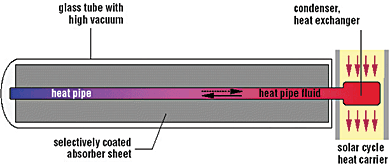
Heat transfer from the
absorber to the fluid circuit is performed by the "heat pipe", a
closed system, evacuated and charged with a small amount of a water-alcohol
mixture before it is sealed. The absorber imparts heat to this mixture, causing
it to evaporate. The steam rises to the upper end of the heat pipe where it
transfers heat to the fluid circuit via a metallic conduction bridge. Being
a "dry" connection, fluid in the heating circuit does not flow through
the collector.
A circulation pump brings heated fluid into the house and delivers it to a
solar storage tank. A controller keeps everything tuned to the changing solar
conditions and temperature set-points of the house. Depending on the number
of tube arrays installed, a system can be designed to deliver the stored heat
directly to a domestic hot water system, an in-floor hydronic system, a heating
coil inside a forced air plenum, a swimming pool, or a combination of these
applications. At these efficiencies, and with the effect of the vacuum, you
can even collect significant heat during cloudy periods.
As you can see in the picture, the entire frame of the evacuated tube solar
collector sits on four feet attached to the roof, resulting in easy watertight
installation on the roof and no friction on the shingles. Maver is proud of
the fact that, while the design of the system and the choice of all the right
components for a given installation needs professional experience, the installation
can be easily handled by your own carpentry and plumbing crews.
There is competition in the field of evacuated tube solar collectors. Maver
feels that it is important for someone unfamiliar with the products available
to research the real efficiency of a given product and its long-term capacity
to maintain its vacuum seal. She is convinced that her product has the best
track record. Her glass tubes have been tested to withstand 35mm hail and
all the primary performance testing has been done in Swedish, German, North
American and Artic environments. This is not a mild-weather import.
The economics of this type of solar system are best realized when it is used
year round. Therefore, it will take advantage of the vacuum technology during
the cold months. For instance, it can be used to supply your DHW all year,
or perhaps heat your pool in the summer and supplement your home heating during
the winter. Furthermore, a system could be set up to consider your DHW as
priority, and any excess energy could be used for heating a pool or hot tub.
The combinations are endless.HB