 |
The energy used to heat water for the home is usually wasted when the water is discharged after use. But with energy efficiency all the rage among builders and consumers, the feasibility of recovering this heat was recently studied at the Canadian Centre for Housing Technology (CCHT).
Drain water heat recovery takes advantage of the fact that water clings to the sides of vertical drain pipes through surface tension and thus facilitates heat capture from the drain pipe. Testing by the CCHT showed that drain water heat recovery can be effective in reducing the amount of energy needed to produce hot water for showers and for prolonging the availability of hot water during periods of high demand or continuous shower use.
What does that mean for the average home owner's bottom line? With energy prices ever rising, the potential savings for a typical household could well be in the $150 per year range, depending on local conditions.
Showers Save Most
The study produced a standardized test that will allow manufacturers and utilities to compare the performance of the several commercially available heat recovery products. Most important for builders, the study led to the development of a web-based calculator that can be used to easily calculate payback.
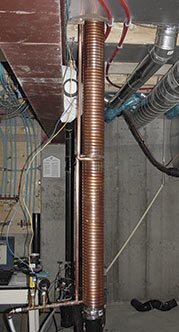
The proprietary heat recovery units tested were 900 to 1,500 mm (36 to 60-in) long and generally consisted of 76 mm (3-in) copper drain pipe wrapped with 9.5 or 12.7 mm (3/8 or 1/2-in) soft copper pipe through which water was circulated to extract heat from the drain water.
Experiments were performed using two different flow configurations, three different flow rates and three different shower temperatures. The daily natural gas savings were measured for four daily schedules of hot and cold water draws.
In most homes, water use falls into three key categories: cold water only (toilets); both hot and cold water (sinks, clothes washers and baths/showers); and hot water only (dishwashers). Within this last category is a sub-division between functions that involve simultaneous hot water draws and warm water discharges (sinks and showers) and those involving delays between hot water draws and warm discharges (clothes washers, dishwashers and baths).
Testing examined the impact of intermittent flows on energy savings and determined that the best heat recovery is obtained from long, simultaneous uses, such as showers. The heat recovered from intermittent uses was found to be inconsequential. Households with frequent shower use will therefore benefit from installing a drain water heat recovery unit more than households where bathing is more prevalent.
New Tool for Builders
The study findings have since been incorporated into a web-based energy savings calculator that estimates the energy cost savings that can be expected from simultaneous shower flows by using drain water heat recovery. The calculator estimates energy savings based on city location (for cold water supply temperature and energy cost), length of use, temperature and frequency of showers, type of showerhead, method by which water is heated and type of heat recovery unit.
The on-line calculator includes a correction for seasonal temperature changes in cold water supply. It defaults to energy costs that existed when the calculator was developed, but a user can alter unit costs for electricity, oil and natural gas prices.
Marianne Armstrong is a research officer in the Building Envelope and Structure program of the NRC Institute for Research in Construction. John Burrows is an engineer and technical writer.
To sample the energy savings calculator visit: http://ceatech.ca/calculator/
For the full CCHT report on drain heat recovery visit: http://www.cmhc.ca/odpub/pdf/65680.pdf