 |
Why Is an Adjustment Needed?
Radon is a colourless, odourless, radioactive gas that occurs naturally in the environment. Outdoors, it dissipates into the air and concentrations are rendered negligible. But when it is emitted into an enclosed space, such as a building, it can accumulate to high levels and become a carcinogen.
Radon primarily seeps from the soil into buildings through sump holes, dirt floors, floor drains and cinder block walls. Soil gas with a high radon concentration can also travel through cracks in foundations and concrete floors. As a result, the gas concentrates mostly in basements or first floors. Although concrete slab basements allow for less soil gas entry than do unfinished dirt-floor basements, both types of surfaces can permit radon infiltration. Other factors such as damp proofing, good concrete quality, excavations free of organic material and ventilation contribute to reducing the risk of radon entry into basements.
Studies linking radon to lung cancer prompted the federal government to review this guideline in collaboration with provincial and territorial governments. Health Canada has since reduced its guideline for acceptable radon levels within buildings from 800 Bq/m³ to 200 Bq/m³. This guideline affects new and existing construction where the building is occupied for more than four hours per day. It is also in line with the limit set by the Environmental Protection Agency in the US and with those of most other countries.
An In-depth Review
Even before the guideline was lowered, the Standing Committees of the Canadian Commission on Building and Fire Codes, which develops the NBC, were discussing changes to specifically address radon ingress. In addition, a task group to review current requirements in the NBC was already being put in place.
Once established, the task group determined that no technical changes were needed to current air barrier and sealing requirements. They did, however, recommend a simple restructuring of existing requirements to improve their effectiveness and applicability to all homes across the country. The recommendations included moving sealing and soil gas control requirements to the section dealing with air barriers to increase their visibility and emphasize that air barriers included those below ground as well as above.
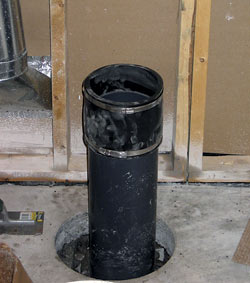
To bring the NBC in line with the new Health Canada guideline for radon, the task group recommended that, even though no technical changes were necessary, a rough-in requirement for a future exhaust system and a good air barrier system in below-ground assemblies be added. This would facilitate post-construction radon removal should that subsequently prove necessary. It would also resolve confusion created in applying the current code, which in one section states that every house should be protected, but goes on to state that where it could be demonstrated that radon was not a problem, no action was required.
Radon levels in homes vary considerably based on a variety of factors such as local geology, building design/operation, and seasonal variables. These factors can also vary widely from one house to another even if the two are similar in design and next door to each other. Unfortunately, radon can only be determined to be a problem after a house is finished and occupied, when all the walls and windows are in and the house is being used in a normal fashion. As a result, once radon is determined to be a problem, it is usually too late and too costly to add the infrastructure to remove it. Requiring that every new home be equipped with a rough-in to eliminate radon gas would ensure that, should it prove necessary, mitigation could be easily and cost-effectively carried out.
The proposed changes will be submitted to a public review in September 2009 and, if approved, included in the 2010 edition of the NBC.
For more information on these proposed changes, contact Frank Lohmann at the NRC Institute for Research in Construction. Frank Lohmann is a technical advisor in the Canadian Codes Centre at the NRC Institute for Research in Construction. Phone: 613-993-9599, e-mail: frank.lohmann@nrc-cnrc.gc.ca