BUILDING SCIENCE
Right-Sizing HVAC Systems in the Era of High Performance/Low Load Homes
By Philippe Verhas
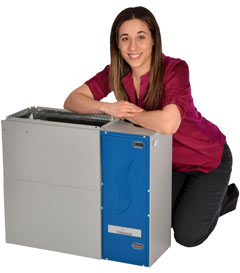 |
| Jacinthe Nichols, R&D Project Leader for the recently introduced Dettson Chinook compact gas furnace, shows just how small this unit is. With a heat output of 15,000 BTU, the Chinook meets the needs of energy efficient multi-family condos and apartments from 50 to 150 square meters (500 to 1500 sq. ft.). |
With the evolution of building codes, the growth of the multi-family market, and the introduction of Net Zero Ready or Net Zero Energy homes, the energy required to condition new, efficient homes has been reduced by more than 33% in the last few years. With this reality, builders have to consider the impacts of better-insulated homes and their resulting thermal requirements. This discussion needs to involve builders, mechanical contractors and trades, HVAC equipment manufacturers, as well as building science professionals. The good news: HVAC systems can now be designed to take advantage of the energy conserving features of this type of construction.
Old Design Rules Don't Apply
When it comes to HVAC systems, old design rules of thumb don't apply to high performance houses. For example, the old 4"x10" registers under every window simply are not needed with a high-performance building envelope. Old design rules also won't provide the healthy, comfortable and efficient home we are striving to produce. But here's more good news: Builders (and HVAC designers and installers) have the opportunity to re-think how comfort is provided.
A "right-sized" system approach, including the integration of small ducts for air distribution, can improve energy performance and reduce the overall costs for the HVAC system. Smaller low- to medium-static pressure ductwork, combined with right-sized equipment, means a smaller mechanical room or elimination of duct-hiding bulkheads, and more living space in a given floor plan.
Traditionally, we would consider a low-capacity gas furnace to be in the 60,000 BTU/hr range. However, some manufacturers now offer 15,000 and/or 30,000 BTU/hr units. A BTU/hr output matched to the thermal load of the house is not the only aspect to "doing it right."
Getting in the Zone
The biggest opportunity of a central HVAC system in high-performance homes is looking at individual room loads, their CFM requirements, and the BTU/hr needs in heating and in cooling. Lower loads allow for smaller equipment and, when combined with smarter controls, can provide more comfort. The next step for leading builders is to introduce zoning capabilities. Having a balanced system with the right airflow, the right BTU/hr and static pressure is a perfect opportunity for a zoned system.
Nailing down the proper CFM matched to the room load provides the potential for optimal comfort throughout the living space, without the annoying noise usually heard with traditional high-airflow systems. High-performance building envelopes have less street noise, which results in quieter homes. This means that the noises generated within the home, such as moving air and motors, become even more noticeable to the occupants. A "right-sized" system offers lower noise with sound levels below 50 decibels right at the furnace and falling to the mid 30s in the individual rooms. By way of comparison, typical conversation between two people occurs at approximately 60 decibels.
Lower airflows and continuous operation can also reduce stratification of the air, thereby providing a more uniform room temperature. Such a system also has the ability to interlock with the ERV/HRV, so that it can provide adequate, fresh, ventilation air to the occupants.
Mechanical Systems
As noted, the airflow rates of these "right-sized" systems are low (between 100 CFM and 350 CFM). In order to function properly, we must ensure that all of the air gets to where it is intended to go so this means the ductwork must be tight. We recommend a maximum of 10% air leakage. To achieve these low levels of duct leakage, continuous ducts or good sealing of the duct joints is necessary.
A "right-sized" system requires a fully modulating appliance and outdoor condensing heat pump unit. Modulation provides the desired performance year round in all climate zones.
From a builder perspective, "right-sizing" the mechanical systems and the ductwork can mean lower overall costs of their systems while optimizing some other costs through less constraints to the floor plan from the HVAC system. It's been proven also that a right-sized system will offer an opportunity to the builder for fewer callbacks or warranty issues due to uncomfortable rooms and mould. To the homeowner, the "right-sized" system delivers lower energy bills and improved comfort throughout the home.
This approach has been well documented in recent years with many monitored installations. Leading builders across Canada are now making this "right-sized" system their standard package. Between now and the end of the year, several Net Zero homes will be built using a "right-sized" system, including modulating heating and cooling equipment and smaller, well-sealed ducts with the airflow sized for the room loads.
Philippe Verhas, Eng, is Research and Development Director at Dettson Industries. He can be reached at pverhas@dettson.ca or visit www.dettson.ca.
Jacinthe Nichols, R&D Project Leader for the recently introduced Dettson Chinook compact gas furnace, shows just how small this unit is.
With a heat output of 15,000 BTU, the Chinook meets the needs of energy efficient multi-family condos and apartments from 50 to 150 square meters (500 to 1500 sq. ft.).
External Links: Associations & Governments. Builders & Renovators . Manufacturers & Suppliers
Home . About Us . Subscribe . Advertise . Editorial Outline . Contact Us . Current Issue . Back Issues . Jon Eakes
© Copyright - Work-4 Projects Ltd.