EXPERT OPINION
Building a Low Carbon Home
It’s easier than you think
By Chris Magwood
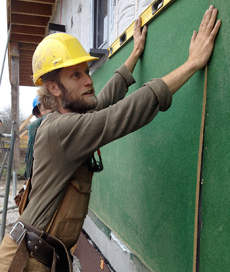 |
Wood fibre board sheathing can replace |
Whether or not you consider yourself an environmentalist, and regardless of your position on climate change, it is impossible to deny that buildings are responsible for an overwhelmingly large slice of the carbon emissions pie. U.S. figures attribute 46.7 per cent of all carbon emissions in that country to the making and operating of buildings, and with Canadian federal and provincial governments ramping up plans to reduce carbon emissions, the building industry is firmly in their cross hairs.
However, there is very good news for home builders in the upcoming “war on carbon.” Our industry can very easily play a leadership role in helping to combat climate change. And not only can we can make an important difference, we can do it without making major adjustments to our practice, unlike many other sectors of the economy.
Understanding Building Carbon
To understand how our industry can turn the corner and be leaders in carbon reductions, a builder has to understand where all that building carbon comes from.
“Embodied carbon” is the amount of carbon that is released during the harvesting, manufacturing, transportation and installation of building materials. Some of the materials we use on a regular basis have a very large carbon footprint. In fact, sometimes a material can be responsible for carbon emissions that outweigh the material itself.
At the same time, other materials have very low carbon emissions. Some materials can even have a “carbon sequestration” effect, and actually store more carbon in the material itself than was generated on its path to the building site, giving them an overall negative carbon impact.
Fortunately for home builders, it is as easy and cost effective to build a radically low carbon home as it is to build a carbon hog.
Informed choices when it comes to selecting and specifying materials are the key to reducing the carbon footprint of our homes. In every product category, there are competing materials with varying carbon impacts. Choose the right materials and you are a climate change champion; choose the wrong ones and you are the problem that governments are trying to solve. And the differences can be very significant, even if the finished house looks and performs the same, see chart.
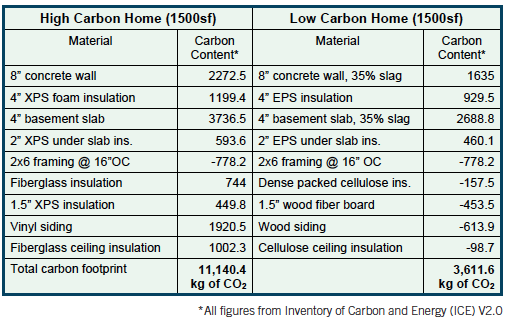
As you can see in the chart, two houses built to identical plans and specifications can have radically different carbon footprints—as much as 68% per cent different! One house can be seen as a part of the problem, and the other as part of the solution. The difference in carbon footprint equals more than 1.5 million tons in carbon reduction over 200,000 homes annually, making this an important contributor to overall national reduction targets.
It just so happens that the carbon friendly choices we can make can also have a positive effect on the Canadian economy. As you may have noticed in the chart, “bio-fibre” products—largely wood-based—are the best choices, and they are also largely Canadian-produced products.
 |
Cellulose insulation actually sequesters carbon, and offers competitive R-values and costs. It can be dense-packed into walls and loose blown into attics. |
You’ll also find that there is no additional price tag for the low-carbon options. In fact, some of them are less expensive than their carbon-heavy competitors.
Of course, there are even more effective ways that home builders can further reduce carbon output. As the chart makes clear, basements represent the biggest percentage of the carbon footprint of an average home. Shallow foundations can result in homes that are carbon negative, and low-carbon choices throughout the rest of the home can continue this positive trajectory.
It won’t be long before governments start requiring home builders to be part of the carbon reduction solution. Fortunately for us, becoming leaders leaders in the fight against climate change is something we can do without dramatically changing our practices.
Chris Magwood is a designer, builder and teacher working for The Endeavour Centre, a not-for-profit sustainable building school in Peterborough, Ontario. www.endeavourcentre.org
External Links: Associations & Governments. Builders & Renovators . Manufacturers & Suppliers
Home . About Us . Subscribe . Advertise . Editorial Outline . Contact Us . Current Issue . Back Issues . Jon Eakes
© Copyright - Work-4 Projects Ltd.