BUILDING SCIENCE
New Research and Technology Sets the Stage for Energy Retrofits
By Jay Nordenstrom
With Canada awaiting details from the federal government on specific actions to meet our national climate change goals, the importance of improving the energy performance of existing homes is once again attracting attention.
While the energy efficiency of new homes has dramatically cut the growth of emissions from houses, improving the energy performance of older homes is the obvious and necessary key to continuing to reduce housing-related GHG emissions.
A new study commissioned by NAIMA Canada, using data collected by Natural Resources Canada (NRCan), puts this into perspective. The study looks at the energy saving potential in Canada’s existing housing stock and draws on data from actual audits of 634,000 homes in all provinces and territories. It is the first research of its kind to measure energy performance in a representative way.
The study set out to determine how many homes in Canada are under-insulated and to estimate, both regionally and nationally, the energy and cost savings that could be produced by upgrading homes to contemporary standards.
The data is impressive. According to the analysis, some 6.2 million existing homes have attic insulation levels at least R-20 below current code requirements. For reference, of the five building components studied, ceilings with attics represent 49 per cent of the total retrofit potential.
At aggregate, how much energy could be saved annually if all existing homes were fully upgraded? The analysis estimates this at 3.10 billion m3 of natural gas, 12.3 billion kWh of electricity, and 742 million litres of fuel oil. In terms of GHGs, this totals 4.26 million tonnes per year.
If all communities across Canada upgraded to the full retrofit potential, the dollar savings would also be materially significant to the homeowners’ pocketbooks, and to our environment. As an example, a homeowner in Edmonton heating with oil or electricity would see savings of up to $400 annually. If the home is also air conditioned in summer, these savings would be higher.
The executive summary of the NAIMA Canada study is posted online at www.naimacanada.ca. While the analysis of the aggregate potential for energy savings in existing homes is important, this needs to “translate” into retrofit action by millions of homeowners to be realized.
 |
MyHEAT
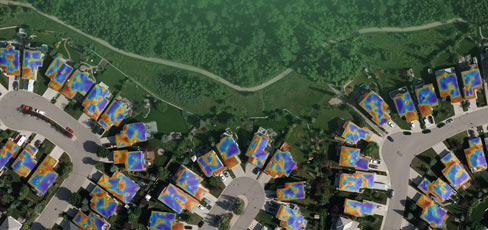
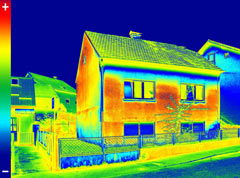
An exciting new tool has emerged to help motivate homeowners to make energy retrofit investments: MyHEAT technology. Now available for Calgary, Edmonton and three other communities in Alberta, MyHEAT helps homeowners to visualize the amount and location of invisible waste heat leaving their homes.
The MyHEAT website provides scalable imaging of entire communities, with all homes imaged according to the amount of thermal infrared energy (3-5 µm) emitted from the roof features.
MyHEAT technology quickly, and economically, collects large area, high fidelity, geometrically and radiometrically correct thermal infrared (TIR) imagery. These data are then processed with peer-reviewed algorithms to reveal individual buildings’ heat loss details, as well as comparable energy efficiency metrics over a town or city.
Using MyHEAT, consumers can not only “see” the waste heat escaping at the neighbourhood level, they can then zoom in to see details for their own home and how it compares.
MyHEAT further enhances consumer understanding by providing “HEAT Scores” which are individually calculated for every building based on measured roof temperature range and average, as well as the total heat loss from the building footprint.
HEAT Scores allow all homes to be ranked based on their total heat loss and are highly correlated with energy consumption.
With improved data on the aggregate energy efficiency potential of Canada’s existing housing stock, and effective new tools like MyHEAT that can make this meaningful for individual homeowners, the “table is set.” The final element is for government to bring forward effective incentives to kick-start the next wave of energy retrofitting across Canada.
All told, these developments should provide tremendous business opportunities for professional renovators and contractors who provide energy upgrading services.
Jay Nordenstrom is Executive Director of NAIMA (North American Insulation Manufacturers Association) Canada.
External Links: Associations & Governments. Builders & Renovators . Manufacturers & Suppliers
Home . About Us . Subscribe . Advertise . Editorial Outline . Contact Us . Current Issue . Back Issues . Jon Eakes
© Copyright - Work-4 Projects Ltd.