Passive build sets airtight record
February 1, 2018
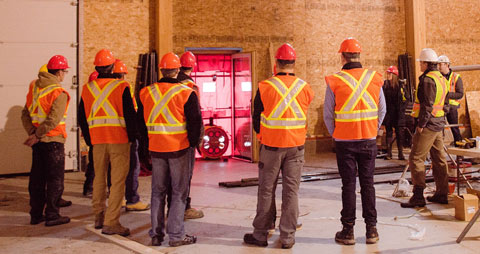
The Wood Innovation Research Lab (WIRL), currently under construction in downtown Prince George, B.C., set a Canadian record for air tightness for buildings of its type.
During testing on January 17, the University of Northern British Columbia (UNBC) building scored 0.07 air changes per hour at 50 pascals pressure.
This means that very little air enters or escapes the building, improving its overall efficiency, interior air quality and comfort level.
Airtight levels are one of the criteria for achieving Passive House certification.
The minimum airtight score for a Passive House is 0.6 air changes per hour at 50 pascals pressure. WIRL scored almost nine times better.
During testing the building was pressurized, and the pressure difference and air flow were calculated. Then the building was de-pressurized, and the same tests were conducted again.
By the nature of their airtight design, Passive Houses have better indoor air quality than conventional buildings, including lower carbon dioxide levels and comfortable humidity levels due to superior ventilation, explained Dr. Guido Wimmers, chair of the Master of Engineering in Integrated Wood Design program at UNBC.