B.C. home builders rap municipalities for high costs, delays
April 25, 2022
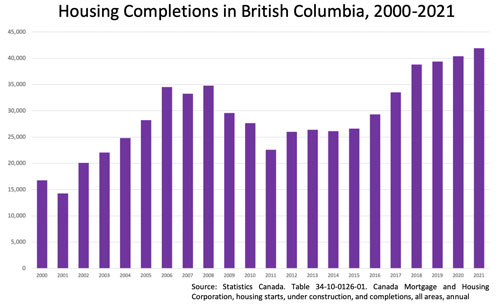
Housing starts in B.C. 2000-2021
The Canadian Home Builders’ Association of BC (CHBA BC) is disputing a new report from the Union of B.C. Municipalities (UBCM) that discusses progress made on affordable housing and the approach that should be taken to address the issue.
“Almost daily, we’re told that fixing B.C.’s affordable housing crisis is a simple matter of supply and demand, and that local governments aren’t doing enough to approve more housing to be built quickly,” reads the paper titled Building BC: Housing Completions & Population Growth 2016-2021.
The paper argues resolving the affordable housing shortage is much more complex than just building more homes.
It states tackling affordability will require incentivizing the right supply including affordable rental housing and co-ops, and addressing the market-skewing influence of speculative demand.
“Statistics show too much new housing construction is investor-driven and that is contributing to high prices for anyone trying to get into the housing market,” reads the report.
The report cites data from Statistics Canada, including the 2021 Census, that shows the number of houses being completed in B.C. closely matches its population growth. (See graph).
However, CHBA BC argues the report fails to accurately represent the issue and is ignoring the role municipalities play in it.
“The report deflects any responsibility or accountability municipalities have in significantly increasing our housing stock. The industry sees this as a signal that municipalities remain resistant to reducing red tape, increasing service levels and approving more housing in their communities,” said Neil Moody, CEO of CHBA BC. “We can no longer afford to dismiss the housing supply-demand imbalance, and UBCM’s position frustrates the alignment we need to see at all levels of government to meaningfully and boldly address our housing needs.”
Moody cited data from Scotiabank that shows Canada’s population-adjusted housing stock is the lowest among the G7 countries, and when looking at it provincially, B.C. is well below the G7 average. He stressed the residential market is extremely tight, with provincial active listings 19 per cent lower than this time last year. Moody also noted that although there has been a recent uptick in registered new homes and building permit activity, these numbers are not indicative of the time it takes to reach the permit milestone.
He explained approval periods are generally lower in Alberta municipalities and higher in the municipalities studied in the Metro Vancouver Area. He cited research conducted by Altus Group for the association which found that each additional month a project is in the approvals process adds an average of $351,500 or $2,812 in costs per month per unit for a low-rise project, and $216,300 or $1,730 in costs per month per unit for a high-rise project.