Residential construction costs on the rise
November 28, 2023
Building construction price indexes
Quarterly per cent change, Q3 2023
source: CMHC
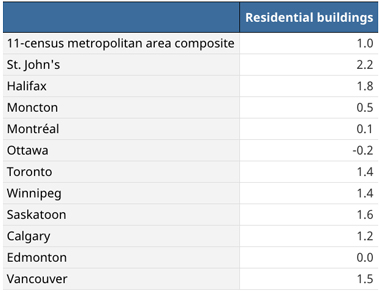
The construction landscape is evolving and Statistics Canada data provides a glimpse into the changing dynamics of the industry. Q3 2023 residential building construction costs are up 1.0 per cent—a slight slowdown compared to 2.0 per cent surge in Q2 2023. Simultaneously, non-residential building construction costs experienced a 0.9 per cent rise, following a 1.6 per cent increase in the preceding quarter.
Q3 2023 growth represents the slowest increase in residential building construction costs since Q2 2020 and in non-residential building construction costs since Q4 of the same year.
Examining year-over-year data for the 11-census metropolitan areas (CMA) composite, residential building construction costs rose by 6.0 per cent, while non-residential building construction costs saw a comparable increase of 5.9 per cent. Notably, Toronto led the way with a 10.0 per cent year-over-year growth in residential construction costs, while Moncton topped the charts with a 12.3 per cent increase for non-residential buildings.
Skilled labour shortages have become a prevalent challenge in the construction sector, impacting wage rates and overall project costs. Factors such as the availability of materials and pressures on interest rates have also contributed to the shifting landscape of construction costs.
In Q3, residential building construction costs increased in nine out of the 11 CMAs measured. St. John's witnessed the most significant quarterly increase at 2.2 per cent, closely followed by Halifax at 1.8 per cent. Ottawa was the only CMA to record a decline in residential construction costs with a marginal decrease of 0.2 per cent.
Breaking down the data for different building types, high-rise apartment buildings saw the most significant growth at 1.7 per cent, followed by single-detached houses at 1.0 per cent.
In the broader spectrum of residential building construction divisions, conveying equipment and masonry recorded the largest quarterly increases at 3.2 per cent and 3.1 per cent, respectively. On the flip side, communications—encompassing telecommunications and cabling products—experienced a decline of 0.8 per cent, while wood, plastics, and composites saw a 0.6 per cent decrease in quarterly prices.
Visit the StatCan site for the full report.