Tradition & Technology
By Noreen Highton
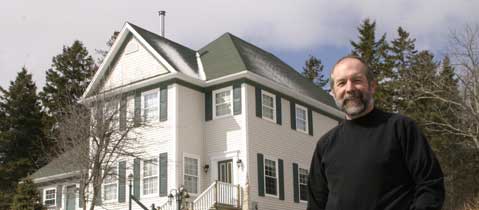
Award-winning builder Joe Waugh links craftsmanship with on-the-edge innovation.
American-born Joe Waugh
first visited New Brunswick in 1970 after hearing raves about the province
in his native New England. It took only a couple of visits before the young
builder began looking for a piece of land on Canada's east coast. By 1974,
Waugh, then 24, had sold his share in a Wisconsin construction company and
joined friends near Sussex, New Brunswick, to begin a new life in a new land.
Now, 30 years later, J. Waugh Construction Ltd. of Cornhill, New Brunswick,
is a respected builder and renovator in Atlantic Canada and is nationally
recognized for its leading-edge work in the field of energy savings. Waugh
first incorporated the strategies introduced by R-2000 into his homes in the
1980s and subsequently made energy efficiency the base for his home building
business. Over the last 20 years he has championed that approach to construction
to builders throughout the Atlantic region and, in fact, across the country.
This year in Banff, Alberta, Waugh was honoured with the national 2004 Award
for Outstanding Energy Efficiency from the Cement Association of Canada for
achievement in homes built with Insulating Concrete Forms (ICFs). Waugh's
award-winning house is estimated to use 42 per cent less energy than the R-2000
energy consumption target, making it one of the most energy efficient homes
ever built in Canada.
Claudia Simmons, executive officer of the New Brunswick Home Builders Association,
says Waugh's success prompted her association "to create an award to
recognize Joe and his team. We presented him with the Most Energy-Efficient
Home 2004 Award." Waugh also captured the NBHBA 2004 ICF Project of the
Year Residential award and has previously been honoured for retrofit and restoration
projects.
Graham Moore, president of the Sussex HBA, says Waugh is "particular
about detail and anyone who's ever built with him has been very happy."
And Waugh appears happy with his life. Over the years he has become a Canadian
citizen and married Jane Achen, a Tai Chi instructor, originally from Saskatchewan.
Together they've raised and home-schooled three children in the pastoral landscape
of southern New Brunswick. He especially enjoys being able to cross-country
ski "right out the back door" during the winter and cycling the
quiet back roads in summer. He doesn't have a Web site because, he explains,
he "doesn't need that volume of business." He typically builds two
custom houses a year, four at the most, in addition to some commercial building
with restoration work or home renovations thrown in for variety.
It's a good life…but for
one thing.
Waugh is concerned about Canada's future in building energy efficient homes.
"For many years, there was a feeling that Canada was at the forefront
of energy-efficient cold climate housing. We have the experience, knowledge
and technology but maybe not the commitment and the actual buy-in that is
happening in Europe, the U.K. and the U.S," he says.
Natural Resources Canada is hoping to address the issue through programs like
R-2000, EnerGuide for New Houses and Building Canada. Waugh, involved in all
three programs, is excited about the possibilities and a bit perplexed that
his excitement is not universally shared. "The range in response to new
information is huge." He explains that established contractors often
don't see the need for change but the young builders he meets in his training
courses and lectures at the New Brunswick Community College are eager to learn
new ways.
Through his involvement in local R-2000 training, Waugh says, "the [energy
efficiency] information has been pretty well communicated to the small hands-on
builders, especially in New Brunswick, but that's making changes one house
at a time." He says it's imperative the large builders get on side if
Canada is to regain its prominence as the world's best cold weather builder.
Restoration
projects
Despite being on the leading edge of building technology, Waugh loves working
with the materials and methods of a by-gone age. In 1980, he was project manager
for the Conservation Council of New Brunswick's restoration and retrofit of
an historic Fredericton property.
Waugh's favourite is the restoration of the Cream Puff Bakery, a 60-year-old
landmark on Broad Street in Sussex. His team stripped off the cladding on
the century-old building and found some of the original brick and metal. They
carefully matched it, added awnings and signs, and restored the building's
façade to its former glory. Luckily, says Waugh, a truck accidentally
backed into Moffat's Hardware next door to the bakery and Waugh's team restored
that 100-year-old building, too.
A favourite story tells a lot about Waugh's business and why he chose Canada.
While he was renovating an old one-room schoolhouse, set in "a beautiful
little valley with a spectacular view," two local "older fellers"
wandered in to see what was going on. They came back often to discuss new
building materials and check Waugh's progress at making the school into a
home. For Waugh, they represented the quintessential Canadian: curious, polite,
friendly and interesting.
Waugh enjoys building where the horizon is still far-reaching and he appreciates
"the role of Canada in the world and its ability to co-operate with other
people." But, mostly, he respects the human side of Canada: "a society
that has public health care, values multiculturalism" and encourages
immigrants, like him, to come and share it. HB