 Safety
Gear
Safety
Gear
New safety equipment may help reverse rising accident rates in new home construction.
On May 1, new construction
safety regulations came into effect in Alberta, following the lead of Ontario,
which had revamped its regulations for the industry in 2002.
The Ontario regulations under the Occupational Health and Safety Act and Regulations
for Construction Projects requires that: "employers ensure that workers
using a fall protection system are trained in its use; training records are
kept, including training dates and participants' names; and the employer makes
training records available to Ministry of Labour inspectors on request."
Failure to comply costs up to $25,000 for individuals and up to $500,000 for
corporations, states the Construction Safety Association of Ontario. The new
Ontario regulations had less than sterling results if one looks at the statistics
for 2003, the worst year for fatal accidents in years. The death toll from
construction accidents in Ontario in 2003 was 30. That was the highest since
1990, when 36 workers were killed.
In the years between 1990 and 2003, annual fatalities had never climbed higher
than 24. Over that period, the average number of fatalities was 20 a year.
Of the 30 traumatic deaths in 2003, more than half resulted from falls, traditionally
the number-one cause of construction deaths. Seventeen of those were killed
on residential construction sites.
"We don't know why the fatalities increased but we don't see a correlation
between the new regulations and the higher fatality rate," said a spokesman
for the CSAO. He noted the new rules didn't come into effect until June of
2002, so the 35,000 construction companies in the province are just now completing
fall protection training.
Part of the reason for the accident increase may be the spike in overall residential
construction, which increased dramatically between 2001 and 2003. It may also
be because of an aging labour force or a labour shortage that has caused contractors
to hire inexperienced help, or because of the number of smaller contractors
now in the business.
According to the CSAO, small construction companies have a much higher injury
rate than larger companies.
In 2003, CSAO notes, construction people were killed by falls even when they
knew how to prevent those falls. In one fatality, guard rails had been in
place but were removed. In other cases, workers were wearing fall-arrest equipment
but failed to tie off. They hit the ground with their harnesses on.
The first Ontario fall fatality this year, in fact, was on a home building
site, when a worker fell from a ladder. "This suggests that last year's
death rate is continuing unabated into 2004," the CSAO noted in its February
newsletter.
The high death rate, and tougher regulations, has spurred manufacturers and
roofing associations to bring forward new fall protection gear. These include
advanced safety harness and anchors, such as "The Claw" permanent
roof anchor system for residential roofers, from Miller Fall Protection, that
accommodates any two-inch-wide wood rafter. It is rated for 310 pounds.
 "We
are looking at a number of new fall protection devices, including Miller equipment,"
said Todd Rogers, chairman of the Safety Committee of the Ontario Home Builders'
Association. Rogers said the main problem is workers not tying their harness
to roof anchors when they are hauling materials onto the roof.
"We
are looking at a number of new fall protection devices, including Miller equipment,"
said Todd Rogers, chairman of the Safety Committee of the Ontario Home Builders'
Association. Rogers said the main problem is workers not tying their harness
to roof anchors when they are hauling materials onto the roof.
One set-up getting a lot of scrutiny, therefore, is the Stacker Bracket Fall
Protection System, from California-based Frame Pro Products. The Stacker Bracket,
designed by a framer, is meant to protect workers who perform stacking, fascia,
sheathing and nailing on the roof eaves of a new house.
The Stacker Bracket has been engineered to meet OSHA standards. The unique
feature is the way it attaches and detaches to the top plate. After the entire
roof is completed, the worker simply removes the safety pin and the top clamp
bolt, and then lets the bracket slip away from behind the frieze block. "It
looks like a good system," Rogers said, who noted that not tying off
is the main reason for fall accidents.
Frame Pro is now setting up a distributor in Ontario, where the system has
already been tested on at least three home building sites. The cost is in
the $5,000 Cdn range, but it is re-useable, so the price is quite low when
amortized over a number of houses. "I know one builder who used the same
set on 100 houses," said Chris Sullivan, Frame Pro general manager.
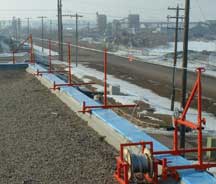
In Alberta, where new safety regulations, the Occupational Health and Safety
Act Amendment Act, came into effect May 1, a group of roofers have banded
together to create a better guard rail system. "We are having it manufactured
in Saskatchewan and hope to be shipping this summer," said Mike Lloyd
of Acron Roofing, who worked on the new system with Harold Bell of Bell Roofing
and other members of the Alberta Roofing Contractors Association.
The guard is made of metal, with no dimensional lumber, and is adjustable
to fit both flat and low-slope roofs. While designed primarily for commercial
roofing, it could be used in some residential applications as well.
Perhaps the most powerful new safety gear, though, is the revised and updated
Residential Construction Safety Guide, developed by the Alberta HBA in partnership
with the Alberta Construction Safety Association. The Guide, which includes
changes brought about by the Occupational Health and Safety Regulation and
Code and explains how builders can work with the new regulations, is being
mailed to all AHBA builder, supplier and trade members free of charge.
The Guide is part an AHBA effort to reduce the number of job-site accidents
and fatalities. In 2003, there were 251 residential construction accidents
reported to the Workers Compensation Board, up from 150 in 2001 and 233 in
2002. In 136 of the cases last year, the workers were injured badly enough
to be unable to report the work the next day. HB